-
28
-
2025-08-27 16:49:08
A wide range of equipment in building mechanical and electrical systems, such as air conditioners, fans, pumps, and chillers, are powered by electric motors. At its core, an electric motor is a masterpiece of magnetism, where like poles repel and opposite poles attract.
Electric motors are categorized into synchronous and asynchronous types. Many industry professionals are unclear about the meanings of “synchronous” in synchronous motors and“asynchronous”in asynchronous motors. Today, we will delve into these concepts in detail.
In simple terms, an electric motor consists of a stator and a rotor. The stator is a large iron barrel on the outside, which generates a rotating magnetic field when energized. Inside, there is an iron block called the rotor, which, as the name suggests, rotates continuously when energized.
The main difference between synchronous motors and asynchronous motors lies in the rotor.
Let's first look at synchronous motors. The most common type of synchronous motor is the permanent magnet synchronous motor, where the rotor is a permanent magnet.
What is a permanent magnet? Exactly, it's a large magnet.
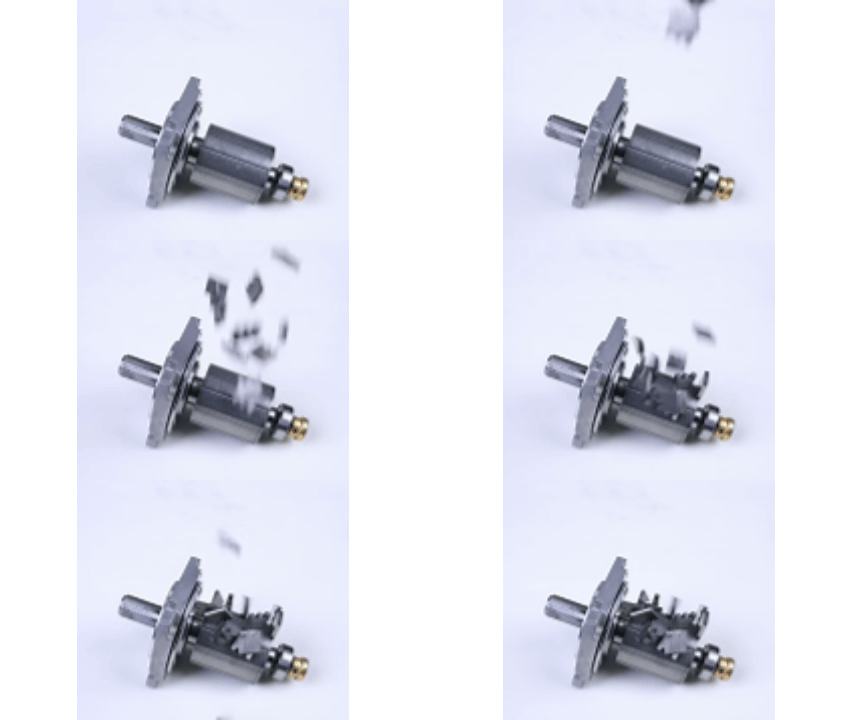
Therefore, when the stator windings of a synchronous motor are supplied with three-phase alternating current, the three-phase currents are phase-shifted by 120 degrees in electrical angle. The magnetic fields they generate in the stator windings change continuously over time, and the combined magnetic field forms a rotating magnetic field. This magnetic field exerts both attractive and repulsive forces on the permanent magnets of the rotor, causing the rotor to rotate along with it.
What does “synchronous” mean?
It is because the rotational speed of the rotor is strictly synchronized with the rotational speed of the rotating magnetic field generated by the stator windings. The rotational speed of the rotating magnetic field is determined by the power supply frequency and the number of pole pairs of the motor.
Ns = 60 * f / P,
Ns: synchronous speed (unit: RPM - revolutions per minute)
f: Power supply frequency (unit: Hz - Hertz)
P: Number of pole pairs in the motor (e.g., a 4-pole motor has P=2 pole pairs)
Example: If the frequency f=50 Hz and the motor has 4 poles, the synchronous speed Ns=60*50/2=1500 RPM
The stator rotating magnetic field rotates at this fixed synchronous speed. Therefore, as long as the power supply frequency and pole pairs remain unchanged, the stator rotating magnetic field's speed remains constant, and the rotor will rotate strictly at the synchronous speed driven by the stator rotating magnetic field, thereby achieving synchronous operation.
However, if the power supply frequency and pole pairs change, does that mean it can no longer synchronize?
Actually, when the stator's rotating magnetic field attracts the rotor's magnetic field, it also generates a force that drives the rotor to rotate, which is the electromagnetic force. These electromagnetic forces create electromagnetic torque on the rotor. However, if the power supply frequency or the number of pole pairs changes, the electromagnetic torque will cause the rotor to adjust its speed to adapt to the new rotating magnetic field speed, thereby re-establishing synchronous operation.
The difference with an asynchronous motor lies in the fact that its rotor has no magnetic properties.
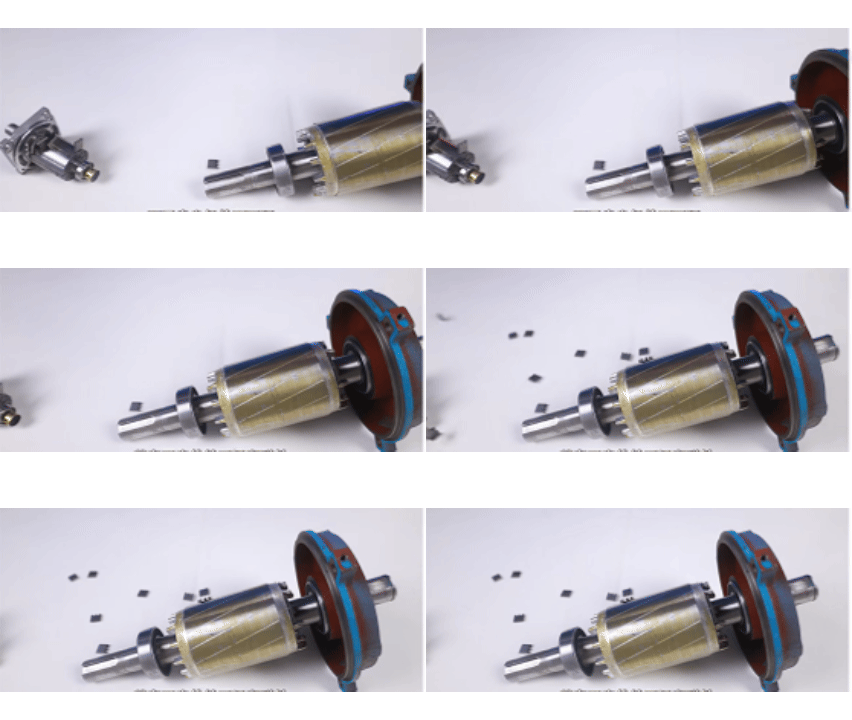
How does it rotate and function without magnetic properties?
AC asynchronous motor:
Rotor construction: The most common rotors are squirrel-cage (composed of conductive bars and end rings, resembling a “squirrel cage”) or wound (the windings are connected to external resistors via slip rings). The rotor itself does not have an independent excitation source (it is not a permanent magnet and does not generate a magnetic field when energized).
Why is it called asynchronous? Simply put, it's because the rotor's speed and the rotating magnetic field's speed are never the same. The asynchronous rotor is driven by the magnetic field but can never catch up to its speed. If it did catch up, there would be no relative motion between the rotor's conductors and the rotating magnetic field, so it wouldn't cut through the magnetic field lines. As a result, no induced electromotive force or induced current would be generated. The electromagnetic torque would disappear, and the rotor couldn't keep spinning. Additionally, when the driving force is too small, combined with internal friction and energy losses within the motor, the rotor's starting speed will be lower than the stator magnetic field's starting speed. As a result, the rotor's rotational speed will always be lower than the stator rotating magnetic field's rotational speed, thus creating a speed difference.
According to the formula, a four-pole motor can achieve 1,500 RPM. However, due to the speed difference, a motor can only reach 1,440 RPM.
Working Principle:
A. The stator rotating magnetic field cuts through the stationary rotor conductors.
B. According to the law of electromagnetic induction (Faraday's law), the rotating magnetic field cutting through the rotor conductors induces an electromotive force in the closed rotor circuit (squirrel-cage conductors or windings).
C. Since the rotor circuit is closed, the induced electromotive force generates an induced current.
D. According to the electromagnetic force law (Ampère's force), the rotor conductors carrying the induced current experience an electromagnetic force in the stator's rotating magnetic field, which drives the rotor to rotate.
Conclusion
“Synchronous” refers to the fact that the rotor speed of a permanent magnet synchronous motor strictly equals the synchronous speed of the stator's rotating magnetic field during stable operation, with both maintaining a consistent phase angle.
“Asynchronous” refers to the fact that the rotor speed of an AC asynchronous motor is always lower than the synchronous speed of the stator's rotating magnetic field, with a necessary speed difference (slip) between the two. It is precisely this speed difference that enables the motor to operate.
Understanding the core difference between “synchronous” and “asynchronous” lies in grasping the relationship between the rotor speed and the synchronous speed of the stator's rotating magnetic field, as well as how this relationship influences the mechanism of torque generation.